2026-02 Changes
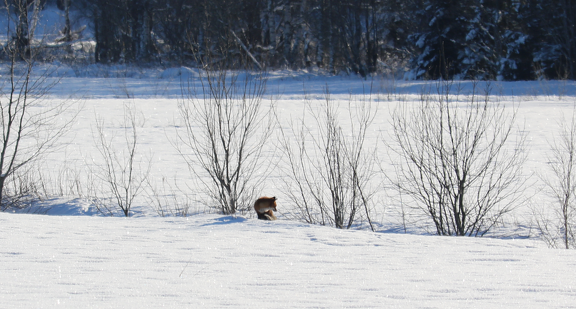
February has had enough snow for the snowmobile riders to be happy. We see them coming past the house and across the fields, and when we’re out on walks. The foxes have also been out a lot, sat in the sun in the field opposite the house. They stay far enough away that they have good visibility of any movement, but the distance makes them hard to photograph in detail. However, by eye it’s easy to see they are out there as they are an unexpected dark spot in the familiar white field.
Ski Exercise
Although February is a lot brighter, it’s still dark in the evenings after work and so it is important to make the most of the weekends. Exercise and sunlight exposure are important. I took a short trip on the wooden skis up to the community stuga (a wooden cabin) west of us. I used rough skins over the skis to let me use the skis like snowshoes to go uphill to the stuga. I’m probably using totally the wrong technique, but luckily there is no one around to see.
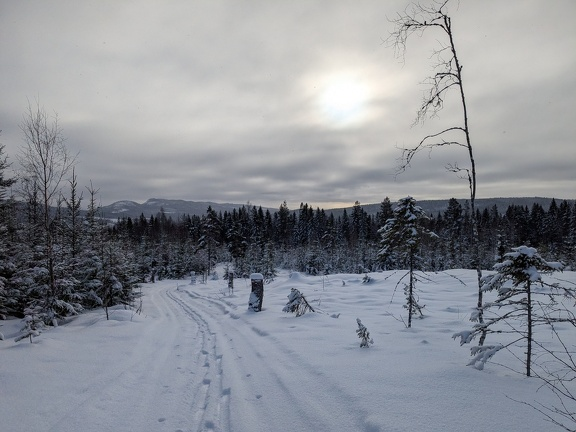
Although it looks cold in the photos, there was no strong wind and the bright sun helps a lot. It’s just a case of wearing layers and managing ventilation so as not to get damp from sweat. I also have an awesome hat that can only be worn in the coldest weather because it is that warm and fluffy, and because it looks a bit “special”.
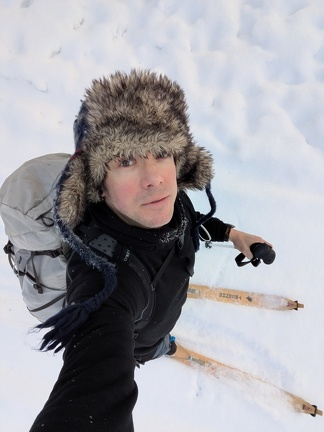
Once there I cleared a good amount of snow from around the community stuga. The clearing means people can access the door easier and sit down on the benches outside in the sun. I took lots of breaks. Deep snow is tiring to move and I’m getting older. I didn’t want to hit my maximum heart rate in the middle of nowhere, just in case. I didn’t clear the whole thing, someone else will need to do the other side.
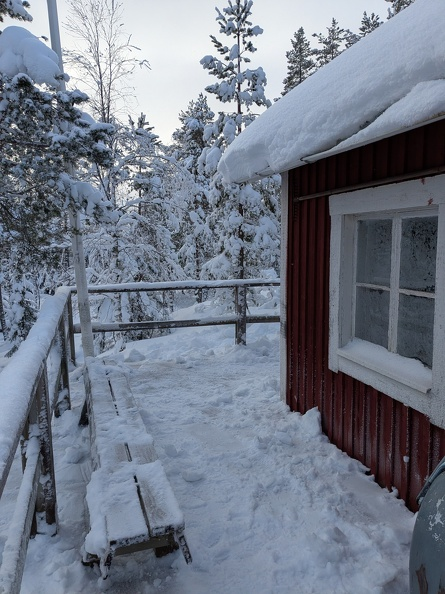
This isn’t the most popular community stuga because there’s no significant view. Since the stugas construction, the surrounding forest has grown taller. A local commented that the way the logging regulations work means that the current standing trees have to remain. Because it is less popular, it does make it a quiet place to visit.
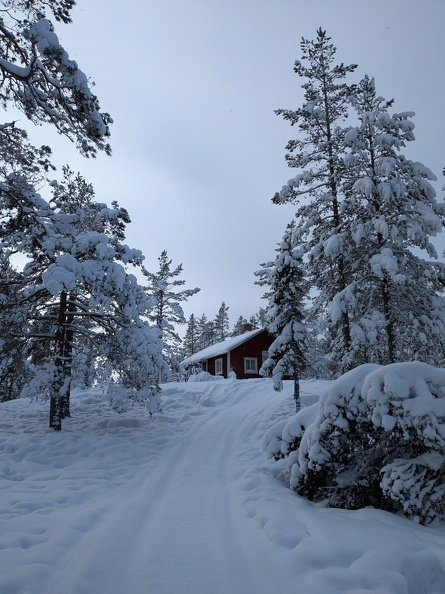
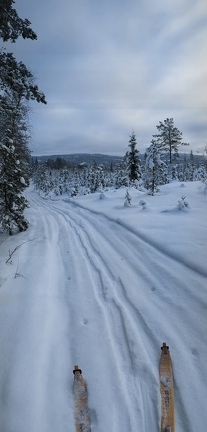
The route down was narrow so I cowardly took the skis off and walked most parts. I messaged my neighbour to ask what the right technique is to go down this kind of route, without doing 40kmh into a tree, and he sent back a laughing emoji. I’ll figure it out one day. Maybe some short skis are the way to go – I’ll have to read up on it.
Changing Citizenship Requirements – 8 year
In the news, Sweden is changing its rules on the requirements for citizenship. The process is being made tougher to attempt to force better integration from immigrants. It is understandable but will affect our application that is in progress.
It looks like all current unprocessed Swedish citizenship applications, which were submitted under the current 5-year minimum continuous residency requirement, will be cancelled in June 2026. This includes our application. The new requirement is for 8 years of residency so we won’t be able to apply again until 2028. The new rules are still a little up in the air. There will be a language requirement and some form of test on knowledge of Sweden, but neither are yet determined.
Likely the language requirement will be CEFR B1 which is sensible and reachable with study and time.
So the news of the inevitable rejection of the application is a little frustrating but we have resident status, which is good. It means this doesn’t impact us as greatly but there are differences between resident and citizenship status:
- Currently we would be easier to deport (in the event of some kind of issue we can’t foresee).
- We also don’t have the right to vote.
- We can’t work in some defence-industry roles, which are big employers locally. There are two significant employers near me that this rules out, such as BAE Bofors who make the CV-90 and are currently building them as fast as they can due to the Ukraine conflict, and the threat of future political instability from the actions of Russia and the current US administration. They are employing anyone that can weld and it’s caused a shortage of welders locally.
But it’s just a matter of time, and we’ll work it out.
Visiting the Metal Fabricators
I needed a lintel to support the brickwork above the old hatchway in the basement heating room. I knew the local metal fabrication company was the best bet. I drew a diagram of what I wanted on paper, double-checked my measurements and wrote the sizes on it, then headed over.
I was a bit nervous, because your average welding and fabrication workshop is far off the tourist trail. There is also a certain character to the way that rural and industrial companies work, like a customer might need to know to use the small door round the side of the building, not the main door which no-one uses. And everyone knows this except you. But it went fine. The owner was there and I think diagrams with sizes are a universal language. We chatted a bit and he understood the requirement. He was really patient with my Swedish. I’d asked for an I-beam cross section which wasn’t available in the size I wanted, but we discussed an alternate box section. He said he would have a look through his supplies and get back to me.
I came back a few days later and picked up a box section cut to the size I needed.
I was able to ask about laser-cutting of sheet metal for future projects although I had to lookup the unusual words. I was thinking that if I can get the metal cut, I could build a solid welding table for the garage for future projects, without spending excessive amounts. It would also be another order arranged and completed with the fabrication company which might build up trust which could be helpful for bigger projects in the future.
Fitting the Lintel
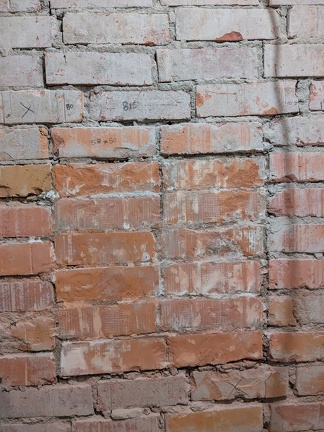
I filed the edges of the cut metalwork to remove burrs. I then painted the metalwork with a thick brush-on primer and let it cure in the garage for a couple of days, as the primer gives off a lot of fumes. The existing brickwork (see photo below) should be easy to remove but I left it in place until the metalwork was dry so as to minimise the amount of time the brickwork was unsupported for. The plan was to remove the top line of bricks, start a cut into the two sides of the hatchway with a concrete saw, and then fit the lintel. After the lintel was set I’d finish cutting down the sides of the old hatchway, and remove the resulting loose brickwork.
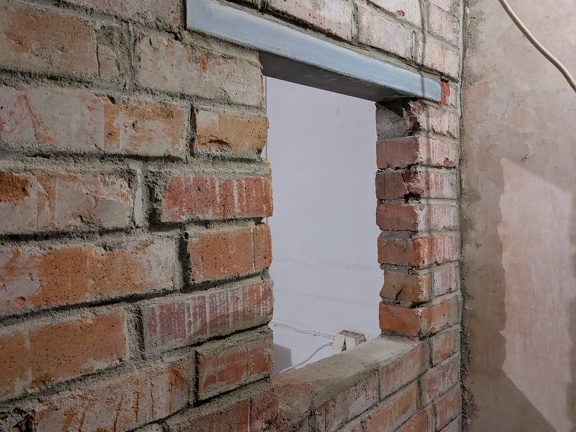
I knocked out the brickwork from the old hatchway top and cut one of the bricks shorter. This let me ensure there was space for 150mm of overhang/support on each side which is needed by building code. Using the gap that it made, I could cut into the mortar of the hatchway using a reciprocating saw (“tigersåg“) and a blade for cutting concrete. I then mixed up some mortar and set about installing the lintel. The old brickwork either side was far out of level. I was able to reduce the tilt a bit by altering the mortar depth, but couldn’t fix it totally. Once the lintel was set I removed the doorway bricks by separating them with the tigersåg, a brick at a time.
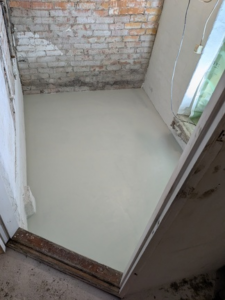
I replaced one fractured edge-brick. The new brick and wet mortar is visible in the bottom left in the photo below. I then used mortar to level the bottom of the opening. My pointing work is rough, but it’s better than the wall was before and it’ll be covered up soon. I’ll need to build a hatchway from wood or metal next.
I’m still struggling to get lime (kälk) delivered. I’ve got some time pressures coming up and need to finish this so I might have to use the softest sandy mortar I can to surface the wall with. Sometimes it’s more important to get a job done, than it is for the job to be perfect.
Investigating the Basement Ceiling
I managed to get visibility above the heating room ceiling. The ceiling is 75mm tongue-and-grove wood (råspont) which is thinner than modern sizes and so isn’t a size I can readily replace. Above the ceiling looks to be bags of sawdust. Normally I’d take it all down and get a good look inside. However, I’m tempted to put everything back as I found it, as it’s not broken and I have some time pressures approaching.
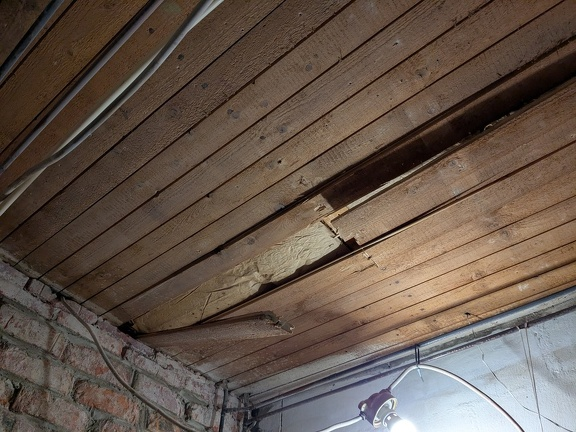
The floor joists are quite far apart compared to modern construction that I’ve seen. If money and time was no object I might take the opportunity to reinforce the joists, but that’s not the case.
Walk on the River
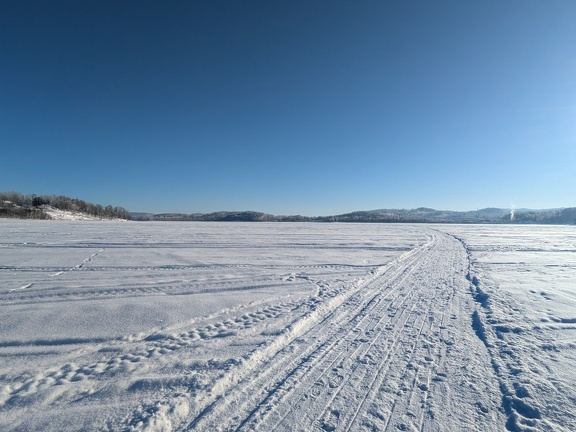
We took a trip to a large town and walked out on the frozen river outlet nearby. There were ice fisherman, fishing through holes on the ice. We gave them space but I’d love to do my own fishing one day.
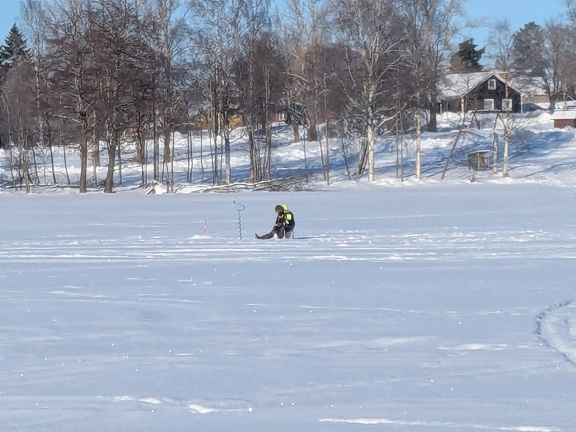
Out on the big flat surface it was really cold, both our noses started to burn from the frostbite and we had to cut the trip short.
Snowshoe Hike Up to the Stuga
The snowmobile club had a meetup at the community stuga to the north of us. I thought it would be cool to meet new people and talk to them. My wife baked some cookies to take and I headed up in snowshoes.
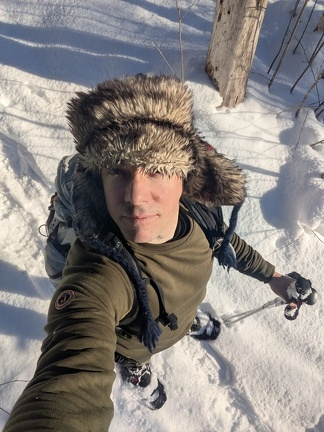
It isn’t far, but is a bit of a workout climbing the elevation in snowshoes. I was also conscious in the forest that although there aren’t normally bears, I did have a rucksack full of freshly-baked cookies. Although it was below zero I got really hot on the climb.
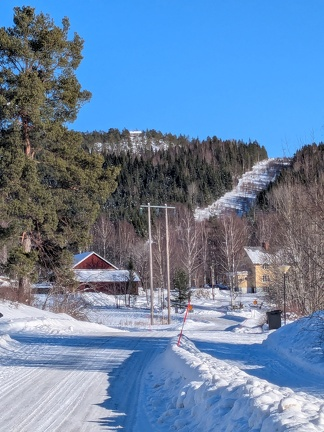
It was a bit of a disaster on my part. I underestimated the scale of the meeting. There were snowmobiles everywhere and the cabin was packed-out with people and families. I gave out some cookies but I don’t think people were looking to meet new people, it was more of an event to take family to. I didn’t want to push more cookies on people or be a cling-on to the one person I recognised, so after a while I put the snowshoes back on and headed back.
In hindsight from looking at my friends photos who went later on, the trick is to go at the end of the time for the event and hang around with the people that just want to chat. I went at the start – I’ll know for next time.
Upcoming Redundancy
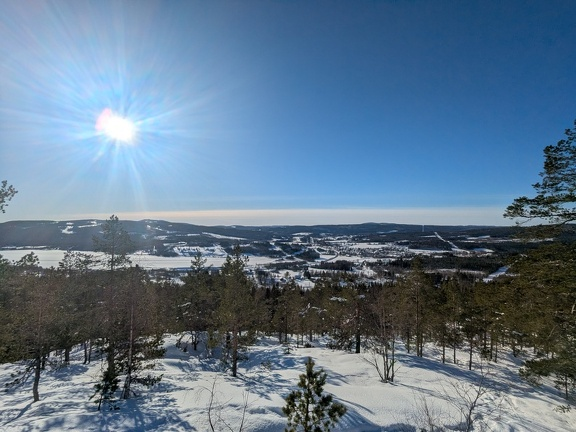
The UK clearance situation needed for my work position has changed and towards the end of the month I heard that working remotely isn’t going to be possible any more, I’ll lose the clearance in the next month. My workplace has been great to me, since I joined before COVID in 2020, but my position isn’t sustainable without the clearance. This situation isn’t a surprise, and I’ve been saving up a financial safety net for 2 years in anticipation of this notification. I’ve got a month of work remaining and a month of gardening leave.
Options
The immediate options I can think of are:
- I can setup self-employed for my current profession, and perform occasional subcontracted non-sensitive work. This is reasonably straightforward to setup.
- As we head into March it’s also when the local companies are advertising for summer seasonal work. That work can be everything from warehouse work to planting trees. That might mean more opportunities to meet people and might be a gateway to something more longer-term.
- As a wildcard, I could train up as a drone pilot for offering surveys of buildings and areas. There’s a lot of regulation but it would be quite cheap as far as startup ideas go. Due to the unattractive paperwork, there would be little competition, but I’m not sure there is work to support the idea yet. I’d need to research it further. Ultimately, when people need a drone, lots of people likely just ask their neighbour or family member, but perhaps there are some more specialist tasks.
- I could train up as a welder, which is in high demand (detailed stats). I have enough welding equipment to get practising. It would take me a month or two of solid practise to be good enough for basic apprentice welding tasks, but there would be work doing this. It would also be a job within the local community. Welders are certified to a specific qualification, with sign-off from an employer every 6 months and re-certification every 2-3 years. There’s a free course at the local college but it’s a year long and during the working week. There’s a commercial 40-day course but it costs 10000SEK (about £8k) which is out of proportion to my comfort level in committing to it at this stage. The defence industry to the north is employing any welders they can find, providing they are a Swedish citizens for security clearance, but that does mean there’s also a vacuum of available welders in the surrounding areas.
I’ll need to think though all my options and take action. A complication is that I under certain assessment paths, immigrants need to be earning 80% of the Swedish average for each month to qualify as having been self-supportive, and the average used to set the threshold is heavily weighted by pay scales in the cities to the south where wages are higher. It’s not a problem for our residency status, but if I earn too little it might affect the length of time we can evidence being self-supportive for in a citizenship application in the future, and so delay citizenship.
I’m not keen on claiming any kind of government benefit, but I have been paying unemployment insurance as part of my union membership. Union membership is a massive thing in Sweden and normal. Unemployment insurance (A-kassan) is about 150-300KR a month depending on the supplier. It pays for 80% of your wage for a certain period of months in the event of you being made redundant. I’m not sure if I’ve been a union member long enough to have the protection however, so I’ll have to check in with them to verify my position.
Finances
At the start of this month I ordered material to complete the basement work. I need to collect that material as it’s taken a while to arrive. Next month I need to press on and get the room completed.
The car repair work last month for the snow damage to the black car also is due. I’ll chase the mechanic for the invoice after payday. Both cars are in good order, but could do with underbody rust treatment in the future. The red car will need some bodywork repairs at the end of next summer, but nothing urgent right now.
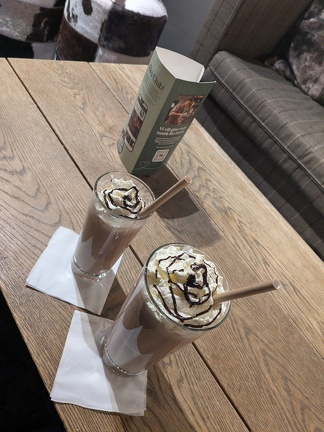
We did go out to the cafe now and then, which is important in winter to help reduce the feeling of being confined. I just budget for it and remember that the little things are also important during winter.
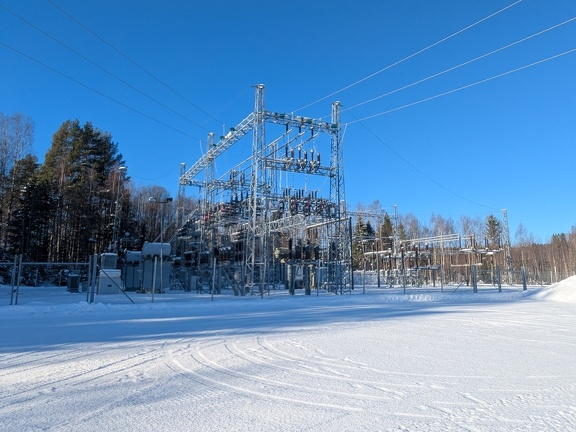
We use electric heating so this month is also when we get the most expensive electricity bill of the year, just over 5100SEK (about £420 or $571USD). That is because January is the month with the coldest temperatures, the highest electricity unit price, and no significant compensating solar. It’s also been colder this year than last year so we’ve used more units of electric. On top of this there has been an unusual situation in our region, causing higher electric prices. This includes a new electric line to export power to Finland, and so increasing demand, but also the wind turbines have struggled with colder temperatures and low wind. But the bills get easier from here to the middle of summer.
A small money-saver was that I managed to repair my hair clippers which saves me a 300SEK haircut each time. The battery had stopped accepting charge after 6 years but I found a replacement online and dismantled it and fitted the new battery using a YouTube tutorial video as guidance.
Other Stuff
We also have another small developing situation which is going to cost a bit, but we have time to prepare. I’ll write about it in the next months.
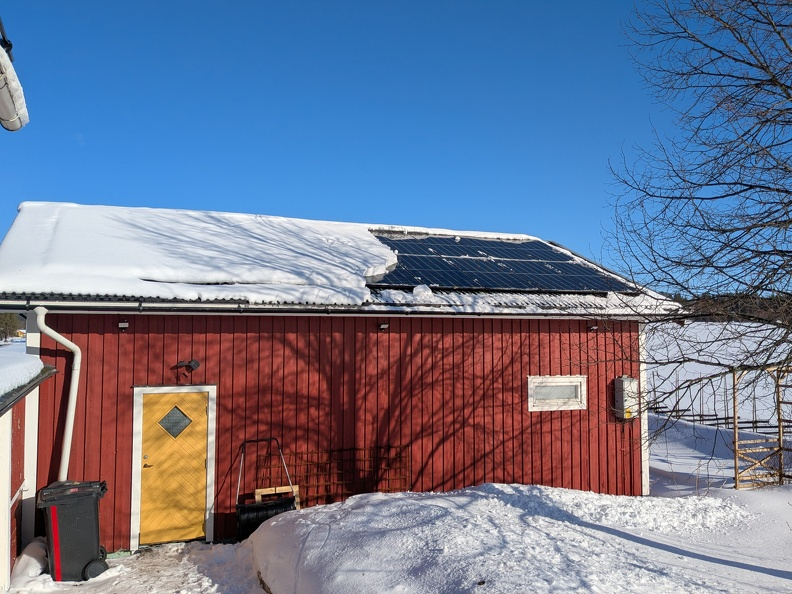
At the end of the month it’s starting to warm up and I’ve been clearing slush and snow in case it freezes overnight in its current position. If the solar panels clear, they will likely stay clear because the black surface will catch sunlight and warm up, melting thin layers of future snowfall. However, going up on a ladder and poking the snow is a bit risky as it would slides off all at once, cartoon style.
I’ve also been digging out around the greenhouse. The more snow I clear on the sun-facing side, the quicker the greenhouse will warm up and self-melt the remaining snow.