Learning Swedish – SFI Course B
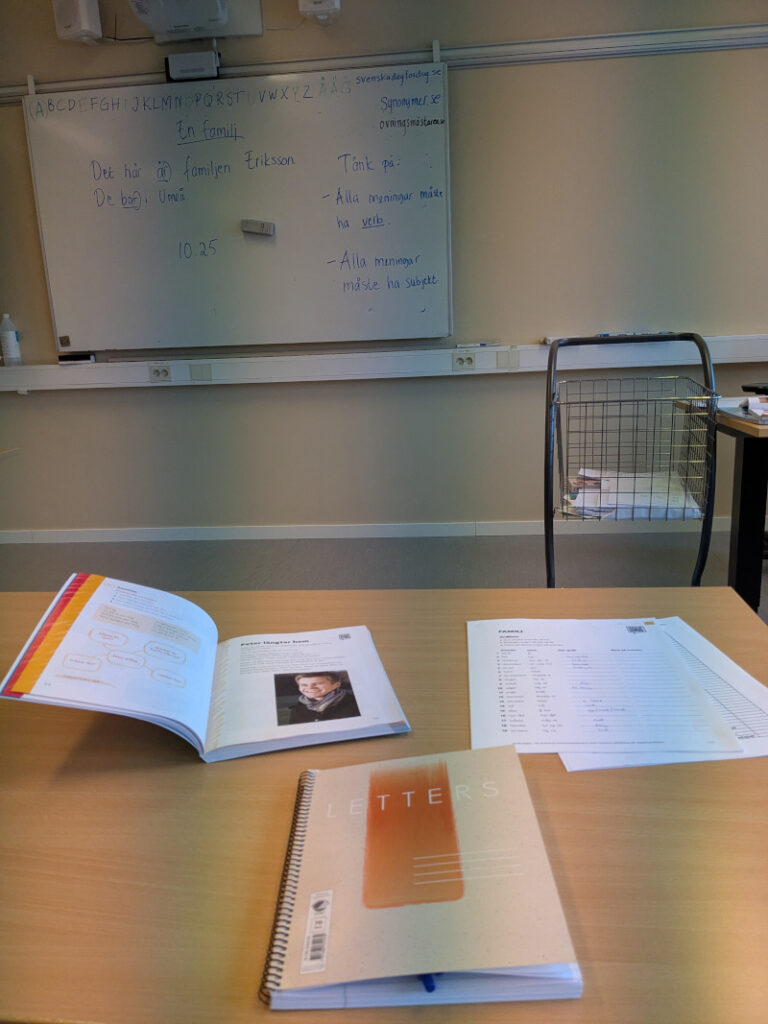
This is a laypersons guide to what is covered by the Swedish For Immigrants (“Svenska för invandrare” – SFI) course that is provided for free by the Swedish government to help immigrants ingrate. SFI has 4 levels, lettered from A to D. I want to describe the course to people that don’t study Swedish and are unfamiliar with learning languages as an adult. This is written from my experience after 3 weeks on course B (“kurs B”).
Studying the items raised in this article would help with passing Course B but it wouldn’t replace the group study experience – I think the majority of the value is in the experience and confidence gained when listening and speaking in a tutor-led environment. Nothing described on this page is especially hard to learn but the difficulty is in doing it all confidently and instinctively when challenged, which takes time and practise.
Language Reference Terms
Learning a new language as an adult also means a crash-course in language terminology. These terms are needed for classroom understanding, but not encountered in everyday life. These terms include:
- categories of word types, like
- verbs (verb) – “doing” words
- adjectives (adjektiv), “describing” words
- adverbs (adverb),
- prepositions (prepositioner),
- pronouns (pronomen)
- conjunctions (bindeord) – words that can glue two sentences together
- verb tenses (inifinitiv, imperativ, presens, preeritum, supinum). For example the equivalent of:
- I will swim
- I am swimming
- I will/shall swim
- I swam (I just realised this is a weird verb in English)
- I have swum
- definitive article, preposition, substantiv, bestämd form
- classroom terms (ördföljd, subjekt, ordlista, meningarna, exempel, plats, tid, nutid, dåtid, motsatsord)
- classroom instructions (frågor, svara, stryk under, översätt, skriva, uttalet)
- …and lots of others
Outside of SFI, I found these hard when I first started doing Swedish in a group tutored environment, because you’re encountering them at the same time as attempting to learn another subject. Almost like having two new languages to learn.
At SFI, neither of the tutors I’ve had has been strict about using the terminology alone, and neither has had a problem with explaining the terms when asked.
Study Concepts
- Write on Paper: You will remember new words better if you write them. The act of writing them helps you remember them. So take some paper and a pen. I use two different colour pens so I can correct my own notes and see the visual distinction.
- Go back over your notes at intervals: periodically such as each week, go back over your notes and summarise what you did, what you got stuck on, key concepts and areas to practice.
- Build up your vocab (the number of words you know) with private study. One person in the SFI group says they are learning 17 new words a day. The most I’ve done in the past was 50 words a day using Memrise which was about 6 hours a day and my limit.
- For extra lessons, watch the YouTube channel “Peter SFI” on your subject of interest.
Behaviour
Hopefully this is obvious, but just in case:
- Make time to do any homework set.
- If you have a question, it’s better to ask it (without interrupting) than to stay silent. You’ll learn faster and the tutor will get to understand where you are at.
- Make an effort to arrive on time to avoid disrupting the class by being late.
- Try not to switch to English. I know it’s tempting. There’s going to be people that dont speak English, and you’re there to learn Swedish. So learn Swedish phrases like:
- I didn’t understand that
- What does “….” mean
- How do I say “…” in Swedish?
- Try to control enthusiasm:
- A little short info on something local is fine but dont derail the teaching with anecdotes.
- If you’ve answered a couple verbal questions from the teacher in a row, let other classmates answer. Maybe write down your answer instead so you can see if you would have been correct.
- A little bit of humour is fine but dont get distracted by lesson-time interactions with other students
- Don’t get distracted or frustrated by classmates that appear significantly better or worse than you. Remember you fit into both those categories depending on which other student is judging you, and it’s not why you’re at SFI.
Personal Information in Classes
In the group lessons, you might get asked personal questions in front of the class as part of practising Swedish. These might include
- Your name
- Your age
- Your phone number (it’s a question on the SFI kurs B discussion cards)
- Where you live
- Your address (again, it’s a question on the SFI kurs B discussion cards)
- Why you emigrated
- What you do for a job
- What you did on the weekend
- If classmates are practising, they might ask how unusual questions as part of practising different verbs and question structure, like much you weigh, or how much you earn.
The key points to remember are:
- You’re in the class to practise Swedish, so don’t break into a big long explanation in English in order to explain some complicated scenario – that isn’t why the person is asking. Just keep the story light and stay in Swedish.
- If you’re not comfortable with giving the answer to a question, just make something up, or otherwise give an answer for a persona/fantasy you prepare in advance. Or you could say in Swedish that you don’t want to answer as it is too personal, which at least one tutor said was an option.
Building Vocabulary
In general you will want to work to memorise:
- A list of common verbs (doing words: e.g. to swim, I swam) in common tenses
- A list of “helpverbs” (such as “can”, “will”, “must” and others : e.g. I must swim)
- A list of common nouns (names: cat, dog, school) and their en/ett status plus the plural form.
- A list of adjectives and their variations (words that describe something: big, small / bigger, smaller / largest, smallest) and opposites (motsatsord).
- A list of question words (adverbs: how often, how many, how much, how…)
You can do this however you want. With paper, Memrise, Anki, or some other method.
In SFI B with verbs we’ve used minor amounts of past tense, and future tense with “kommer att” or “ska” but most often you will need the present tense (I am driving) and infinitiv (I drive a red car).
Knowing and being able to reliably describe the behaviour of the six different verb groups is a skill to learn.
Numbers
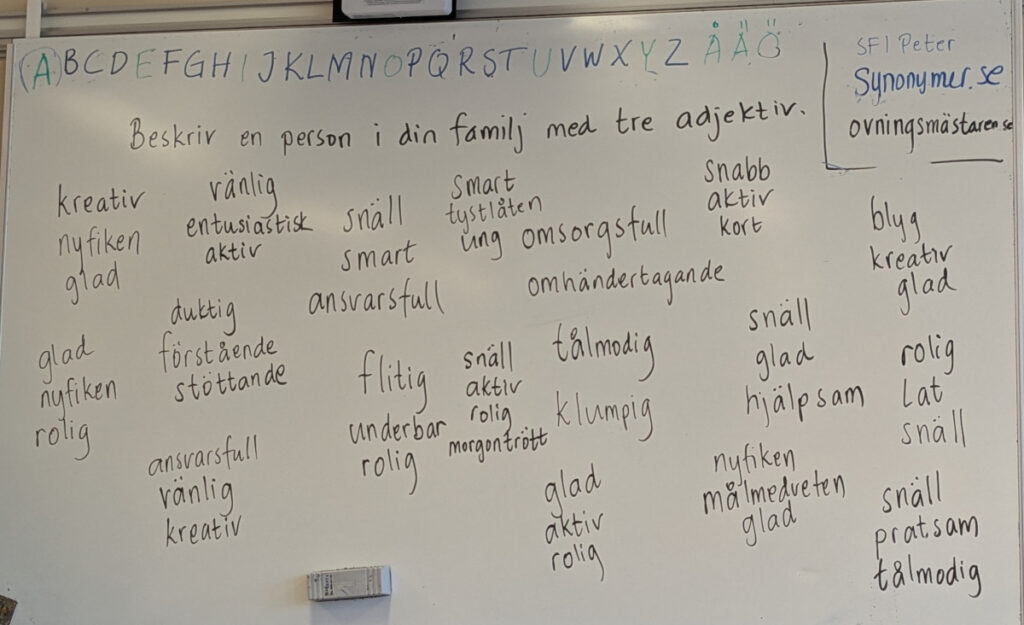
Numbers seem like a straightforward concept to lean, but think of all the different associated ways that you use numbers in English and how you would find your conversations partners responses as “off” if they said things a little differently to what you are used to. Examples include:
- third, forth, seventeenth, thirty-first etc. (Note that in Swedish certain combinations like 8th and 18th can sound similar if mispronounced).
- a “fiver”, a “tenner”
- the right way to say years like “the 1900s” (nineteen hundreds, not 1-thousand-nine-hundreds)
- the correct way to say “in 2020” (twenty twenty, not two-thousand-and-twenty).
- knowing numbers under pressure – I know the Swedish numbers but in a rush to provide an answer to a query, my brain short circuited “fyrti-fem” (45) as “(thirty)-fem” (35) because “fyrti” (swedish) and “thirty” sound so similar, even though my brain pattern-matched on the wrong language.
If interested in more (in Swedish) see the Peter SFI lesson on numbers:
https://www.youtube.com/watch?v=4vJGl93_d9Y
Time
Time seems like something that should be simple.
- Reading the time as a 24 hour clock: same structure as in English.
- Reading the time as a 12 hour clock: same structure as in English.
- Reading the time in long form descriptions: not the same at all. This is a big subject to work on.
- 06:30 == “half seven” (see below explanation, this is not a typo in my blog)
- 06:25 == “5 minutes to half seven” (fem i halv sju), or alternatively “25 over 6”
- 07:55 == “5 minutes in eight”
Sweden uses the same time-description method as German and Russian, in that “half seven” is 6:30. Not 7:30. Think of the full English phrase as being “half […an hour past…] six” and Swedish as being “half […an hour until…] seven” for the same time of 06:30.
Peter SFI lesson on times:
https://www.youtube.com/watch?v=Hkfv2kO8gdA
Sentence Structure
The “V2” rule is heavily discussed online – briefly summarised as that in a normal sentence the verb must be in the second position. But a key concept for beginners is that positions in sentences aren’t necessarily one word long. So for a simple sentence, the structure is “subject – verb – object”. But the subject can be multiple words, for example, “my car” would be two words. So remember that it’s not strictly one word in each described position of the rule.
Word order in questions puts the verb first, unless a question word is used. For example
- “can you speak Swedish?” (a sentence with a dedicated question word “can”)
- “speak you Swedish?” (a question, because the doing word – a verb, is the first word)
The V2 rule is straight forward but it causes a split from English behaviour when we put the time or place first in the sentence. E.g. in English I might write:
- “I break the rule, sometimes”
- the verb “[to] break” is second, so this is a word for word swap to translate into Swedish
- “Sometimes, I break the rule”
- although this order is fine in English, if we directly word-swap this sentence to Swedish, our conversation partner is going to frown, as it will sound wrong to them. Instead we use:
- “Sometimes break I the rule”
- This word order sounds like Yoda in English, but the verb (to break) is correctly in second place. So when a time or place is used first, we move the doing-word (verb) to be second.
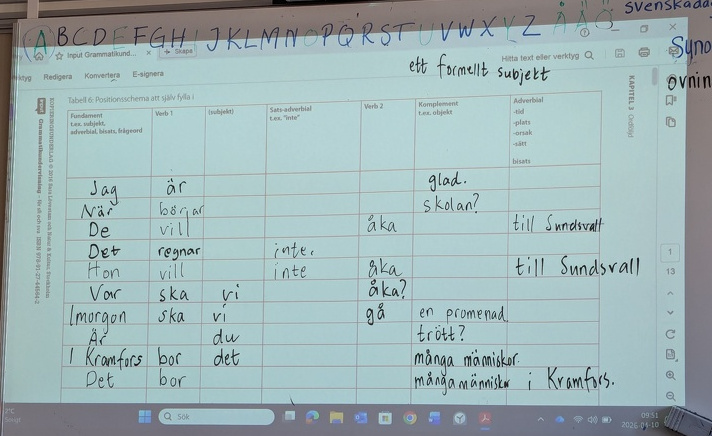
Peter SFI tutorial on word order (in English):
https://www.youtube.com/watch?v=Nz6Es6SIIeA
False Friends
These are words that it’s easy to learn but my brain sometimes miss-links under pressue
- The Swedish “fyrti” as in “fyrtifem” (45) sounds a lot like english “thirty” (e.g. 35 in the example), if you’re used to hearing south-east English accents that pronounce “th” as “f” (“[f]irty”). Counting is no problem, but this causes a speed bump in my mind under pressure.
- Slight tangent: to stress test your recognition, there’s actually a computer game that has you performing tasks such as decoding door keypads with the numbers given to you in spoken Swedish to type in as your character gets shot at by terminator style robots.
- 20-something (“tjugi-“) sounds like “shoe-gi…” which can sound a lot like the northern dialect for 70-something (“shoe-ti…”). This is less of a problem in the south as 70-something is more like “who-ti…”. So at least once I got a number wrong talking to a person with a northern dialect.
- Because some letters in the alphabet are pronounced differently to English, the Swedish pronunciation of “USA” can sound like “[y]ou-ess-are” which sounds a lot like an English speaker saying a sloppy/fast “USSR”. So I have misunderstood the country being discussed at least once before mentally correcting myself.
- In English we have descriptive words, and we can put “un” on the front of them to mean the opposite. Like happy/unhappy. Swedish has something similar by using “o” in front of a word. e.g. “trevlig and “otrevlig” are opposites. So a person might be tempted to assume all “o” words are opposites of the word without the “o”. Except “rolig” (fun) and “orolig” (restless) are not opposites due to a change (or dual meaning) in word usage. The full explanation would take a while but the main thing is to be aware of the exception.
- The verb to want, typically encountered as “vill” in the present tense, sounds a lot like the English “will” and the wrong meaning can fit the sentence, but it means “[to] want”. Again, I know the words but I sometimes have to consciously correct this in my head in the middle of a conversation. Example:
- Jag vill går till coopen.
- Your brain first-pass decodes as “I will go to the Coop”
- But means “I want to go to the Coop”
Gender
If you’re from the UK, you likely had to take a foreign language at school which would typically be French, Spanish, or German. Similar to these languages, Swedish has genders with some terminology history and differences that are not important to this article. The main thing to note is that Swedish has “en” and “ett” words which is a similar (but not identical) concept to French “la” and “le”.
SFI B includes:
- Using the right “en” or “ett” word with a noun. People will understand you if you get it wrong, but the error immediately flags you as having speech flaws in a conversation. Similar to hearing:
- “I would like an apple” versus
- “I would like a apple”
- Using the right plural form. An example of what it sounds like for this to be wrong to a native speaker, is in the English versus American differences:
- Lego versus Legos: “I need to put the lego away” vs “I need to put the legos away”
- Modifying other words in the sentence to indicate the gender or plural status. Interestingly, this once existed in English long ago but still exists in little weird places. One example is below but there are others:
- The lake is big / The lakes are big
I haven’t taken the SFI A course so I suspect that is where the above is explained and introduced. I’ve covered it in learning environments. I’ve not seen a lesson on this in SFI B, but it is something that you’re expected to know exists, and to be correcting yourself on as you learn because it will affect every sentence. As such the concept is present and practised in every lesson.
You and Friends
In English we have “you” for referring to one person, and “you” for referring to a group, or people in general. Which can sometimes cause awkwardness or the need to add extra words like “all of you”.
Other languages typically have a “you” for a singular person and a different word for a collective “you” (you might know of the French use of “Tu” and “Nous”). English used to have this long ago, and to badly summarise a lot of history “you” was the plural form but it also became the polite form to use for referring to an individual, and then over time it got used for both cases. Think of “thou” and “you” in some old English plays.
Swedish has “du” (singular) and “ni” (plural, and formal singular) and some complicated history around the use of them. Essentially some of the older generation remember when “ni” was used in a completely opposite way (in terms of politeness) to how it is now.
For SFI we need to be correctly using words for the subject and object in a sentence. In English this of “We need the forms given to us” which in Swedish would be “vi” and “oss”. So for each of I, you, he, her, we , they and others, you have a corresponding word of my, your, his, her, us, their. In the same way we have to learn the same corresponding pairs for Swedish.
Idioms and other Weird Things
This hasn’t been expressly covered in my SFI experience, probably because they aren’t focusing on a English to Swedish transition. But in short it is import to keep in mind any time you find yourself using a turn of phrase in your home language that it might not translate at all. E.g. try to avoid forming sentences and responses to questions in SFI, that use examples like:
Think of the how many times you used a phrase in English like:
- “On the other hand…”
- there is no hand involved, but in Swedish there is an almost identical phrase you can say: “on the other side…”
- “I’ve left the car running outside” or “I’m just running down to the shop”
- the car has no legs, and likely noone is actually running. In English everything “runs”, in Swedish everything walks (gå).
You can likely think of some distinct idioms, and would deliberately not use them in non-English settings, but some smaller phrases are going to sneak into your speech without you noticing.
Other
Some words dont translate 1 to 1 with English. This is some examples:
- “var/vart” (where) which has two different uses depending on a general place, or a place you are travelling to. The related “varifrån” essentially means “where from”. In case this seems odd, think of historical English plays using words like “whither”/”whence”/”whereto” which are no longer used in English but had this directional distinction.
- Some words that change with usage, like “länge” (long) which is spelt different for each usage scenario of distance, time, and height. There’s no old English equivalent of this as height was always differentiated from distance/time.
- “på”, “i”, “för” roughly follow the English usage for “in/on” and “for” but there are many times they dont. It can feel odd building a sentence in your head that doesn’t have a direct English equivalent.
Things like the alphabet you are expected to know but still be making mistakes on. So some letters might sound similar to each other or be the opposite of what you’d expect in your own language. Examples include:
- being able to correctly hear the difference between a, e, i , j, g, o, u, y, å, ä and ö
- saying the letters above correctly, and letters such as k (sounds a bit like “caw”) and z
Again, I suspect the alphabet is introduced earlier, in SFI A, but the tutor will do ad-hoc mini refreshers, especially if the pupils have miss pronounced something.
Typical Exercises
Typical exercises in class include the following, which aren’t stressful with a supportive teacher. This is not an exhaustive list.
- (Almost every morning) Which day of the week is it? Describe the full date, the weather outside and the temperature.
- Describe the time
- Describe yourself, introducing yourself
- Write 8-10 sentences describing another person
- Highlight the verbs in example provided text
- Listening to another persons description of themselves and then answering questions about what you heard
- Listening to an audio recording and answering questions about what the person said
- For a given description (adjektiv) give the corresponding opposite word. E.g. large/small, happy/sad
- Write sentences using each different hjälpverb (I can swim, I must drive, Erik wants to fish…)
- Write answers to questions
- Write Swedish names against pictures of animals, objects
- Identify incorrect word order in example texts
If you want to practice by yourself or with a Swedish volunteer, there are SFI kurs B discussion cards that cover some of the above tasks.
Encountered but Not Deeply Covered at this Level
The following are probably covered at the SFI levels above (SFI C and SFI D). I’m aware of them from other training I have done and some of them have been lightly discussed on SFI B when bumped into in a students response but I’ve not seen a dedicated lesson on them yet at SFI B level:
- Swedish requires possession in a sentence (sin, sitt, sina):
- Deliberately ambiguous English example: “Mary met Sally. Sally threw her drink on the ground.” – who lost their drink?
- In Swedish, this would have to be solved in the sentence:
- “Mary met Sally. Sally threw [sin (possessive word indicating sally)] drink on the ground.”
- “Mary met Sally. Sally threw [hennes (nonpossessive word indicating Mary)] drink on the ground.”
- Trivia: In English we’d solve this by saying “her own drink”, or repeating the mention of Mary but old English had a very similar set of words to the Swedish that fell out of use hundreds of years ago.
- Dialect differences. These are pretty minor but, for example:
- “7” – pronounced roughly similar to “who” (southern Sweden) versus “shoe” (Västernorrland)
- The equivalent of “fewer” versus “less” for countable versus uncountable amounts. I normally get this right, but via instinctive autopilot – Swedish and English similar for this. But I did manage to get it wrong in one instance, and ideally I need to be able to explain my choice for each situation which is sometimes tricky when you do something without consciously thinking.
- I haven’t yet seen “ja” (“yes”) versus “jo” (“yes”) discussed. English doesn’t have this. It’s a way of answering a negative question with a different form of yes, which removes the ambiguity. E.g.
- “Doesn’t your car work?”
- “Yes” (is that “Yes, it doesn’t work”, or “yes, it does work?”)
- I haven’t yet encountered the “på” versus “i” lesson – the equivalent of the rules used when saying
- “I live on an island”, as opposed to “I live in an island”
- “I am on the bus”, as opposed to “in a bus”